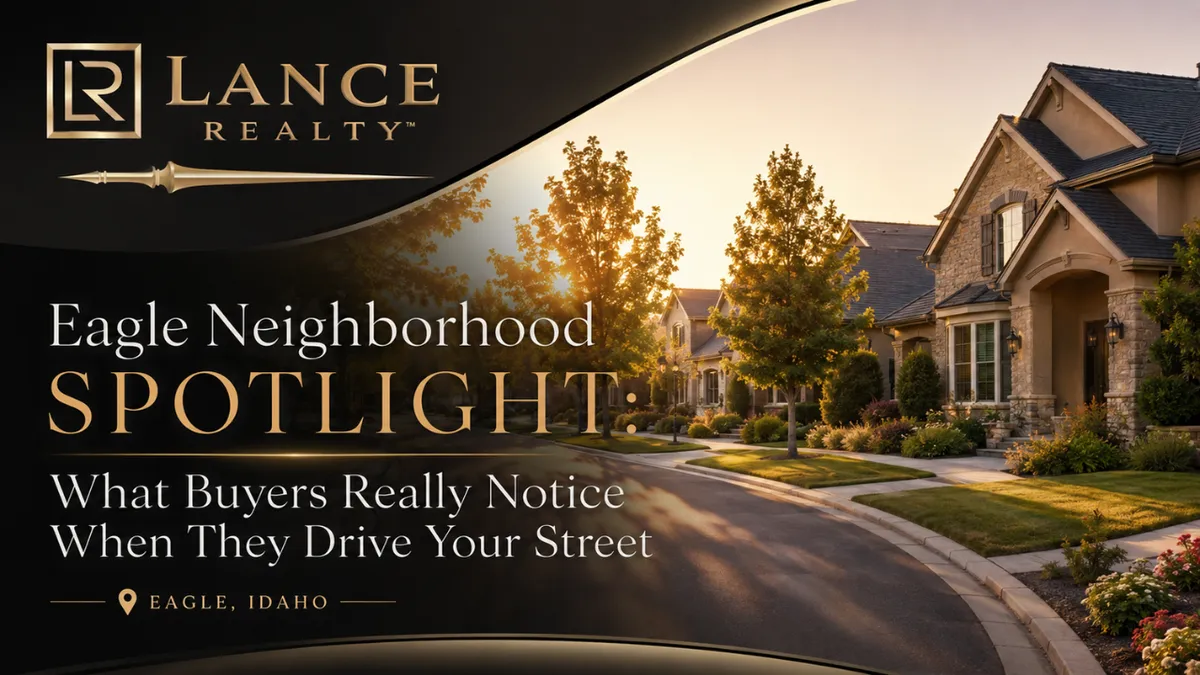
Eagle Neighborhood Spotlight: What Buyers Really Notice When They Drive Your Street
The Neighborhood Question Every Eagle Seller Should Ask
I've worked with buyers and sellers for more than two decades now, and one thing never changes. Before buyers even step out of the car, they've already made a dozen judgments about your home based on the street it's on, the mailboxes they passed, and the feel of the neighborhood the moment they turned in.
Some of those judgments are fair. Some aren't. But they all matter, because buyers buy neighborhoods as much as they buy houses. And in Eagle, where you've got everything from newer master-planned communities like Legacy and The Shores to older established pockets near Floating Feather Road and Beacon Light Road, the neighborhood context shapes how buyers see your home—and what they're willing to pay for it.
So if you're thinking about selling, the first question isn't just what your home is worth. It's what your neighborhood is telling buyers before they even knock on the door. And whether you're helping it—or working against it.
What Buyers Are Really Reading When They Pull Up
Buyers won't tell you this part out loud. But I see it every time I walk a property with a client. They're scanning your street for clues about lifestyle, upkeep, and value before they ever see your kitchen counters.
Are the yards well-kept or patchy? Are there multiple for-sale signs on the same block? Do the neighboring homes feel similar in quality and condition, or does yours stand out in a way that makes it look overpriced? Is the street quiet and shaded, or does it feel like a cut-through between Eagle Road and Highway 55?
I'm not saying you need to fix your neighbors' lawns. You can't. But you do need to understand what context you're selling into, because it affects how buyers evaluate your price, your photos, and whether they even bother to schedule a showing.
Eagle Neighborhoods Are Not All Created Equal—Even When Prices Look Similar
Here's the tricky part. Eagle has some of the best lifestyle neighborhoods in the Treasure Valley—places like Banbury Meadows, Eagle Hills, Avimor, and newer developments like Corrente Bello and Riverstone that attract serious buyer interest every single month. But it also has plenty of smaller pockets, older subdivisions, and rural-feel streets where the market moves differently.
Back in May 2025, the median sold price in Eagle was $958,450. One year later, in May 2026, that number dropped to $885,000. That's not a small move. That's a market that's pricing more carefully, where buyers have options and they're using them.
In May 2026, we sold 93 homes in Eagle. The month before that, in April 2026, it was 72. So demand is still there. But those sales aren't spread evenly across every street and every subdivision. Some neighborhoods are still moving quickly—homes are going under contract with a median of just 9 days on market in May 2026. Others are sitting longer, getting price reductions, and creating a perception problem for the next seller who lists nearby.
Some Eagle Streets Sell Themselves—Others Need Help
I'll give you a real example of how neighborhood perception works. If you're selling a newer build in Corrente Bello or Creekwater, buyers already expect a certain level of finish, modern floor plans, HOA amenities, and walkability. Your job as a seller is to meet or exceed that expectation with how your home shows.
But if you're selling in an older Eagle neighborhood—say, near Floating Feather like Red Leaf Heightsor one of the smaller county pockets off Beacon Light Road—buyers aren't coming in with the same set of assumptions. They might love the space, the lot size, and the mature trees. But they're also wondering about roof age, septic systems, well water quality, and whether your home has been updated or neglected.
That doesn't mean your home is worth less. It means the story you tell has to be stronger, clearer, and more confident. You can't just list it and hope. You've got to position it so buyers see the value instead of the risk.
How to Use Your Neighborhood as a Selling Point—Not an Excuse
If you're in one of Eagle's amenity-rich neighborhoods—places like The Shores, Banbury, Avimor, or Eagle Hills Golf Course—lean into it hard. Show the lifestyle. Talk about the trails, the clubhouse, the pool, the parks. Buyers are paying a premium for that access, and your marketing should make it obvious what they're getting.
If you're in a quieter, less-developed part of Eagle, don't apologize for it. There are buyers who want space, privacy, and room to breathe without HOA dues and a neighbors-next-door feel. Your job is to make that feel like a feature, not a compromise. Show the lot. Highlight the flexibility. Make it clear this is a home for people who value land and lifestyle over cookie-cutter convenience.
And if you're somewhere in between—one of Eagle's mid-range subdivisions that isn't flashy but isn't country either—then your edge comes from condition, updates, and price positioning. You can't out-amenity Banbury. But you can out-value it if your home shows better and your pricing makes sense.
What Buyers Notice That Sellers Miss
Here's what I tell every seller before we start marketing. Walk your street like you've never seen it before. What do you notice? Are there cars parked on the lawn two doors down? Is there construction debris sitting out front across the street? Are the fences sagging? Is your mailbox crooked?
You can't control all of it. But you can control your part of it. And the cleaner, quieter, and more cared-for your immediate block feels, the easier it is for buyers to see themselves living there.
Your curb appeal isn't just your front yard. It's your whole street. And if that street is sending mixed signals, your home has to work twice as hard to make up for it.
Why Pricing Can't Ignore Neighborhood Context
This is where a lot of Eagle sellers trip up. They price based on what they want, or what Zillow says, or what a neighbor's house sold for three years ago. But they don't account for what's actually happening on their street right now.
In May 2026, the median list price in Eagle was $1,049,950. The median sold price was $885,000. That gap tells you something. Sellers are still listing high, and buyers are negotiating or walking. If you price your home at the top of that range without accounting for your neighborhood's current appeal, days on market, and competition, you're setting yourself up to sit.
And when homes sit in Eagle—especially in neighborhoods where buyers have other options—they start to look stale. Even if they're not. Even if the price eventually comes down to something fair. The perception shifts, and you lose leverage you'll never get back.
The Right Way to Prepare Your Home in a Neighborhood That's "Good Enough"
Not every Eagle neighborhood is going to make buyers swoon. That's fine. But your home still needs to stand out within that context. If you're in a solid but unremarkable subdivision, your interior condition, staging, and marketing have to do the heavy lifting.
I work with sellers using a system I call The Seller's Edge. It's a step-by-step approach to getting your home market-ready—not based on guesswork or generic staging tips, but based on what buyers in Eagle are actually responding to right now. That includes everything from room-by-room prep to pricing strategy to how we position your home online so it doesn't get lost in the noise.
If your neighborhood isn't your strongest selling point, then your home's presentation has to be. And that takes planning, not luck.
When Neighborhood Matters More Than Square Footage
I've seen buyers pass on bigger, nicer homes because they didn't love the street. And I've seen them stretch their budget for a smaller home in a neighborhood that felt right. That's the part a lot of Eagle sellers underestimate.
Square footage is easy to measure. Neighborhood feel is not. But buyers absolutely factor it in when they're deciding between your home and the one two streets over. If your neighborhood feels cohesive, cared for, and aligned with the lifestyle they want, they'll pay more. If it doesn't, they won't—no matter how nice your finishes are.
What This Means for You as an Eagle Seller
If you're thinking about selling, start by looking at your neighborhood through a buyer's eyes. Not a neighbor's eyes. Not a nostalgic homeowner's eyes. A buyer's eyes.
What are they going to notice when they turn onto your street? What are they going to assume about your home before they even see the listing? And how can you use your preparation, pricing, and marketing to shift that assumption in your favor?
That's the work. And it's the difference between a home that sells in 9 days at full price and one that sits for 31 days with a price cut. In May 2026, Eagle had both. The ones that sold fast weren't always the prettiest or the biggest. They were the ones that matched buyer expectations for that neighborhood—and then exceeded them.
I help sellers get that part right. Not by hoping the market does the work for them, but by positioning their home with a real plan, real pricing, and real strategy. If that's the kind of guidance you're looking for, let's talk. I'll walk you through exactly what I'd be looking at if I were in your shoes, what your neighborhood is telling buyers right now, and how we make sure your home stands out for the right reasons.
Barry Lance | Owner/Broker/Realtor® | 208-488-1433 | [email protected] | LanceRealty.com



