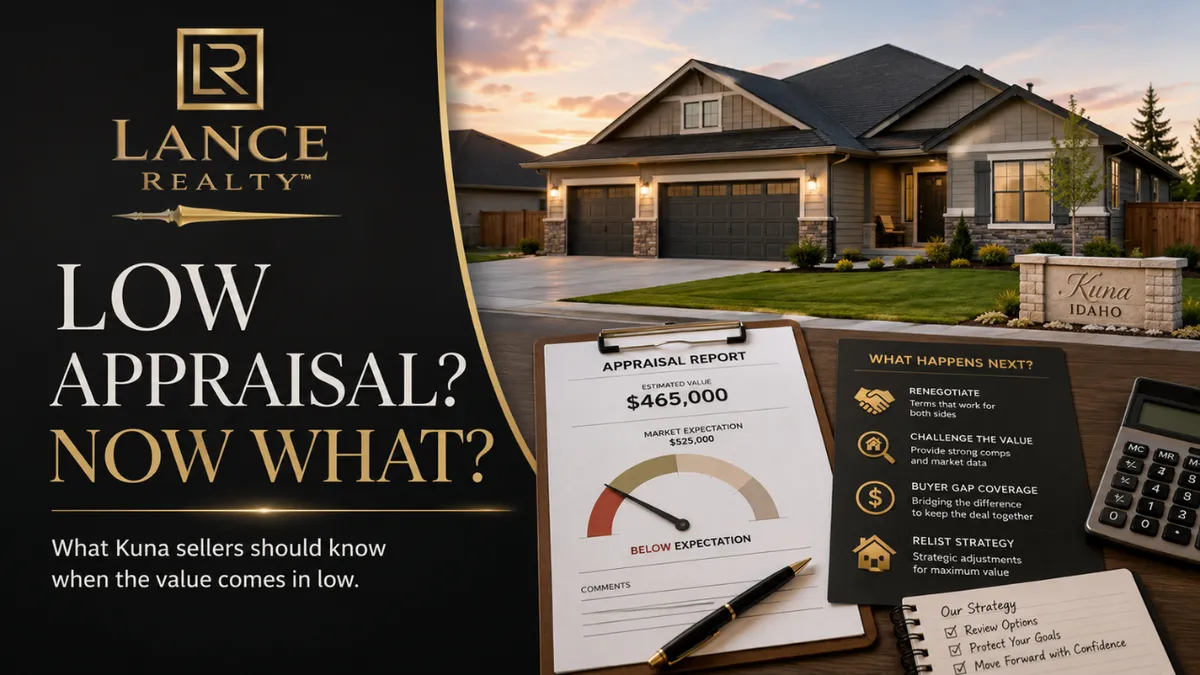
If Your Kuna Home Doesn't Appraise, Here's What Actually Happens Next
The Appraisal Contingency Is Invisible Until It Isn't
You accept an offer on your Kuna home. Price looks good. Buyer seems solid. Everything feels like it's moving forward.
Then the appraisal comes back low. Deal stops cold. Now you're trying to figure out what happens next and whether you're about to lose the buyer, renegotiate the price, or start over from scratch.
Most sellers don't spend much time thinking about the appraisal contingency until it becomes the thing standing between them and a closed sale. But if you understand how it works before you list, you can price smarter, negotiate better, and avoid surprises that cost you time or money.
What the Appraisal Contingency Actually Does
When a buyer is using a loan to purchase your home, their lender orders an appraisal. The appraiser's job is to confirm the home is worth what the buyer agreed to pay. If the appraisal comes in at or above the contract price, the deal moves forward. If it comes in low, the appraisal contingency gives the buyer a way out.
Here's what that means in plain terms. Let's say your buyer offered $485,000 on your home in Crimson Point. The appraisal comes back at $470,000. The lender won't loan more than the appraised value, which means the buyer now has a $15,000 gap to fill. They can bring extra cash to closing, renegotiate the price with you, or walk away under the appraisal contingency and get their earnest money back.
Most buyers can't or won't write a check for that difference. That's when the conversation shifts back to you.
Why Appraisals Come In Low in Kuna Right Now
Appraisals are based on closed sales, not active listings. That's the part most sellers forget. The appraiser isn't looking at what your neighbor listed their home for last week. They're looking at what actually sold and closed in the last few months.
Back in June 2026, the median sold price in Kuna was $467,758. A year earlier, in June 2025, it was $473,745. Prices have softened slightly year over year, and appraisers are working with that data. If you price based on hope or on what you need to walk away with, the appraisal might not support it.
Homes are also sitting longer. The median days on market dropped to 15 in June 2026 from 20 in May, but that's still a slower pace than we saw during the peak frenzy. When homes sit, appraisers take note. It signals the market isn't supporting aggressive pricing in every neighborhood or price range.
If your home is in a pocket where comps are limited or where recent sales were lower-priced resales instead of new builds, you're more vulnerable to a low appraisal. That doesn't mean you can't sell. It means you need to price with the appraiser in mind from day one.
What Happens When the Appraisal Comes In Low
You've got options. None of them are perfect, but they're workable if you know what you're doing.
First option: lower your price to meet the appraisal. If the appraisal came in at $470,000 and you were under contract at $485,000, you can agree to sell at $470,000. You lose equity, but you keep the deal alive.
Second option: the buyer brings more cash. If they've got the money and they really want the house, they can cover the gap. That's more common in competitive neighborhoods or when the buyer is relocating and doesn't want to restart their search. But don't count on it. Most buyers are already stretching to cover their down payment and closing costs.
Third option: meet in the middle. You lower the price by $7,500, the buyer brings an extra $7,500, and the deal closes. This is the most common compromise I see. Nobody loves it, but it keeps everyone moving forward.
Fourth option: challenge the appraisal. If you've got strong comps the appraiser missed or if there's an error in the report, your agent can submit a rebuttal. It doesn't always work, but I've seen appraisals revised when the data supports it. You need someone who knows how to pull the right comps and make the case clearly. This isn't a job for wishful thinking.
Fifth option: the buyer walks. If they can't or won't cover the gap and you won't lower your price, they can cancel under the appraisal contingency. You go back on the market. If that happens, you're not just starting over — you're starting over with a price history that might make the next buyer nervous.
How to Avoid Appraisal Problems Before They Start
The best way to handle a low appraisal is to not get one in the first place. That starts with pricing.
I don't price homes based on what sellers want to net or what Zillow says the house might be worth. I price based on what appraisers are going to see when they pull comps. That means looking at closed sales in your neighborhood, adjusting for condition and features, and being honest about where your home actually sits in the market.
In June 2026, Kuna saw 133 closed sales with a median sold price of $467,758. The average was higher at $514,929, which tells me there's a range of outcomes depending on where your home falls. If you're in a newer neighborhood you might have stronger comp support. If you're in an older pocket your pricing strategy needs to reflect what resale homes are actually closing for, not what new construction is listing at.
Condition matters too. Appraisers note deferred maintenance, outdated finishes, and anything that makes your home less competitive than the comps. If your carpets are worn, your paint is tired, or your landscaping looks neglected, those details can cost you in the appraisal. It's not about making your home perfect. It's about making sure it doesn't appraise lower than it should because of fixable issues you didn't address.
This is part of what I cover in The Seller's Edge System. We walk through how to position your home so it appraises at or above contract price, not just how to get it listed and hope for the best.
What Sellers in Neighborhoods Like Springhill and Memory Ranch Need to Watch
If you're selling in a neighborhood where lot sizes vary, home ages are mixed, or recent sales include both new builds and older resales, appraisal risk goes up. The appraiser has to make judgment calls about adjustments, and not every appraiser sees those adjustments the same way.
Let's say you're in Springhill and your home backs to open space with mountain views. You think that's worth $30,000 more than the comp down the street. The appraiser might agree, or they might adjust it at $10,000. You don't control that. What you do control is pricing in a way that gives you room to absorb a conservative appraisal without killing the deal.
Same thing applies in areas like Crimson Point South or Paloma Ridge where inventory has been heavier and days on market longer. If your home sits for 40 days before going under contract, the appraiser is going to see that. They're going to look at what else sold during that time and whether those homes had to drop their price to close. If the market data shows softness, the appraisal will reflect it.
The Smarter Play: Price It Right From the Start
Here's what I'd be looking at if I were in your shoes. You want your home priced so that when the appraiser shows up, they see a contract price that makes sense based on the data they're required to use. That doesn't mean you price low. It means you price smart.
In May 2026, the median sold price in Kuna was $469,990. In June 2026, it dropped slightly to $467,758. The market isn't crashing, but it's not climbing either. If you price your home like it's still May 2025 when the median was $472,490, you're pricing into a market that no longer exists. And when the appraisal comes back, you'll pay for that mistake in lost time or renegotiated terms.
I also look at days on market. In April 2026, the median was 39 days. By June, it had dropped to 15. That's a good sign for sellers, but it doesn't mean every home sells fast. Homes priced right move. Homes priced hopefully sit. And when they sit, they're more likely to appraise low because appraisers see the market hesitation as a signal.
What You Should Do Before You List
First, get a real market position review. Not an online estimate. A review that looks at closed sales in your neighborhood, adjusts for your home's condition and features, and tells you where your pricing power actually sits.
Second, fix what's fixable. If your home has obvious maintenance issues, outdated finishes, or curb appeal problems, address them before you list. You don't need to remodel your kitchen, but you do need to make sure your home shows as well as the comps the appraiser is going to use.
Third, talk through appraisal strategy with your agent before you accept an offer. Ask what happens if the appraisal comes in low. Ask whether the buyer's offer includes strong financing or if they're stretching. Ask what your options are if you need to renegotiate. The time to have that conversation is before you're under contract, not after.
Fourth, read Your Boise Home Won't Sell in 7 Days — Here's What Actually Happens from List to Close if you haven't already. It walks through the full timeline and what to expect at each stage, including appraisal.
My Job Is to Help You Avoid This Problem
I don't want you dealing with a low appraisal three weeks into your sale. I want you priced right, positioned clearly, and under contract with a buyer whose financing is solid and whose offer makes sense for the market we're actually in.
That's what The Seller's Edge System is built to do. We start with a Private Home Value & Market Position Review so you know what your home is worth and what it's likely to appraise for. We prepare your home so it shows better than the comps. We market it so the right buyers see it. And we negotiate it so you don't leave money on the table or get stuck renegotiating after the appraisal.
If you're thinking about selling in Kuna this year, let's talk before you list. I'll give you the honest answer about pricing, timing, and what to expect from the appraisal process. No guesswork. No surprises. Just a clear plan that protects your equity and gets your home sold.
Have more questions about selling your Kuna home? Visit our Kuna Home Selling FAQ for straight answers on pricing, closing costs, timing, and more.
Barry Lance | Owner/Broker/Realtor® | 208-488-1433 | [email protected] | LanceRealty.com



