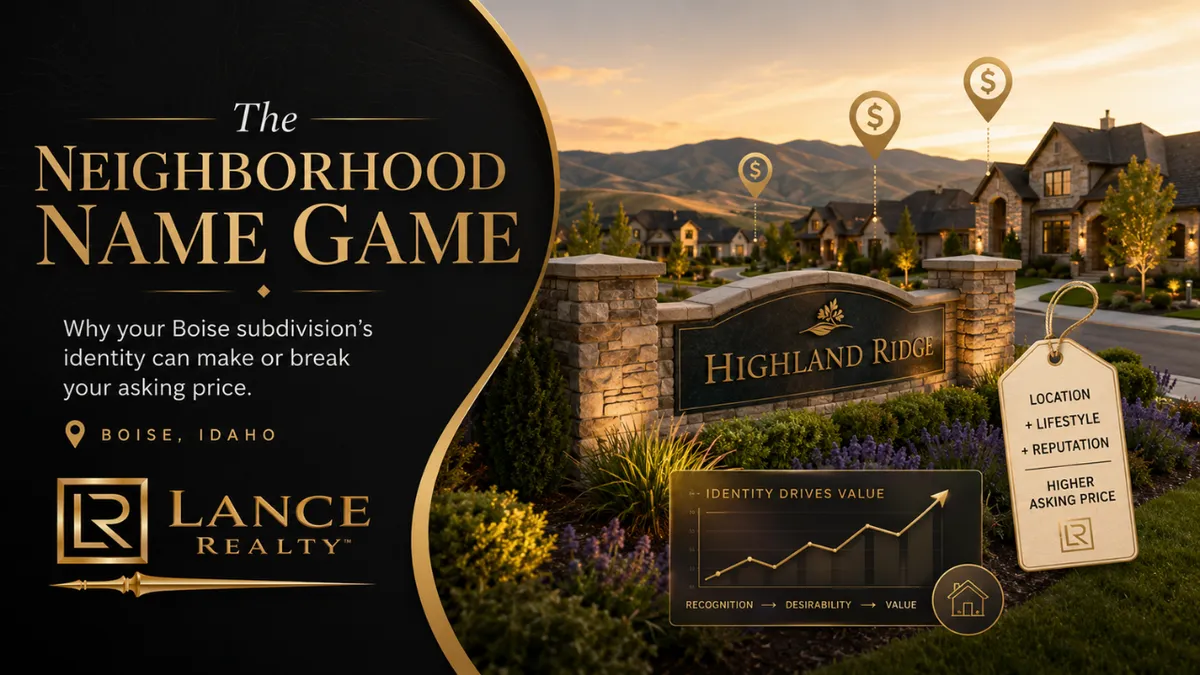
The Neighborhood Name Game: Why Your Boise Subdivision's Identity Can Make or Break Your Asking Price
Your Subdivision's Name Shows Up Before Your Home Does
Here's something most sellers don't think about until they're already committed to a price: buyers search by neighborhood first, property second. They've already decided whether they want Harris Ranch or East Valley, Barber Junction or Hidden Springs. By the time they see your listing, they've already filtered you in or out based on where you are, not what you have.
That matters because Boise is a city of identity clusters. The Waterfront District doesn't compete with Dry Creek Ranch. A townhome in Park Place doesn't feel like a single-family in Cartwright Ranch. Buyers see these areas as completely different products, different lifestyles, and different value propositions. Your home doesn't live in a vacuum. It lives inside a neighborhood story, and that story shapes what buyers expect, what they'll pay, and how fast they'll move.
I bring this up now because in June 2026, Boise closed 356 homes at a median sold price of $572,925. That's up from 324 homes and $549,660 back in June 2025. Inventory is moving. Prices are holding. But not every neighborhood is experiencing the same level of demand or the same pricing power. If you're getting ready to sell, you need to understand what buyers think your area means before you decide what your home is worth.
The Perception Gap Between Seller and Buyer
I talk to sellers all the time who love their neighborhood, and rightfully so. They know the trails behind their house. They know the park down the street. They know the shortcut to Costco and the best spot to watch fireworks on the Fourth of July. That's real value.
But buyers don't know any of that yet. What they know is what they've heard, what they've read online, and what their agent told them in the car. If you're in Avimor, they're thinking new builds, HOA amenities, and commute time. If you're in Southcreek, they're thinking mature trees, central location, and established feel. If you're near Warm Springs Avenue, they're thinking older character homes, walkability, and quirky charm.
None of that is inherently good or bad. But it does mean you can't price or market your home as if it exists in a neutral space. You're not just selling a house. You're selling a house in a specific place with a specific reputation, and your strategy needs to match what buyers already believe about that place.
How Neighborhood Identity Shows Up in the Numbers
Let's talk about how this actually plays out. In May 2026, the median sold price in Boise was $592,500, and homes were moving at a median of four days on market. One month later in June 2026, the median dropped slightly to $572,925, but days on market ticked up to five. That's normal summer rhythm. More inventory, more choices, slightly longer decision windows.
But those city-wide numbers don't tell you what's happening street by street. A home in Harris Ranch priced at $650,000 might sell in three days because buyers expect that price point in that location and they know inventory there is limited. A home in East Valley at the same price might sit for two weeks because buyers shopping East Valley are expecting something closer to $500,000 to $575,000, and your home feels like an outlier.
Same house, same condition, same finishes. Different neighborhood story. Different buyer expectation. Different result.
This is why I never start a seller conversation with "What do you want to list for?" I start with "Let's talk about where you are, who's buying there right now, and what they're comparing you to." That context matters more than your renovation budget or your Zillow estimate.
The Foothills Premium vs. the Commute Trade-Off
If you live anywhere near Bogus Basin Road or the foothills corridor, you already know buyers will pay more to be close to trails, views, and that elevated feel. Neighborhoods like Highlands Cove, Antler Ridge, and parts of Dry Creek Ranch benefit from that halo. Buyers expect higher prices there, and they're willing to stretch for the right property.
But that premium only holds if your home delivers on the promise. If you've got the location but your landscaping is dated, your deck needs replacing, and your interior feels 10 years behind the neighborhood standard, buyers will see the gap. They'll offer lower or they'll skip you entirely and wait for the next listing. The name gets them in the door. The condition closes the deal or kills it.
On the flip side, if you're in a neighborhood that's perceived as more affordable or more functional than aspirational, your job is different. Maybe you're in Columbia Village or Belmar Estates. Buyers shopping those areas are often first-timers, young families, or investors looking for solid bones and good price per square foot. They're not expecting granite and custom tile. They're expecting clean, move-in ready, and fairly priced.
If you overprice based on your upgrades or your attachment to the home, you'll sit. If you price to the market and show well, you'll move fast. That's the difference between understanding your neighborhood identity and pretending it doesn't exist.
New Construction Areas Are Their Own Animal
Avimor, Painted Ridge, River Run ... these newer master-planned communities come with their own set of buyer expectations. People shopping there want low maintenance, modern finishes, HOA amenities, and a sense of newness. If you're selling a resale home in one of these areas, you're competing directly with the builder down the street who's offering incentives, rate buy-downs, and a blank canvas.
Your advantage is that you're move-in ready, you've got landscaping, window treatments, and you're not waiting six months for a build. But your pricing has to reflect reality. Buyers will compare you to the model home, and if your price is higher than new construction without a clear reason why, they'll walk.
I worked with sellers in a newer subdivision last year who couldn't understand why their home wasn't getting offers. It was beautifully upgraded, fully landscaped, and priced $15,000 over what the builder was offering for a similar floor plan with closing cost credits. Buyers saw the comps, did the math, and moved on. We adjusted the price, repositioned the home as the better value because it was ready now, and it sold in six days. Same house. Different story.
The Established Neighborhoods That Buyers Overlook
Then there are the parts of Boise that don't show up on the Instagram highlight reel but offer incredible value for the right buyer. East Valley, parts of Glenwood, older pockets near Fairview Avenue. These areas have character, walkability, mature landscaping, and price points that first-time buyers and young families can actually afford.
If you're selling in one of these neighborhoods, don't try to compete with Harris Ranch or Barber Junction. Lean into what makes your area different. You're closer to downtown. You've got big trees and front porches. You're in an established community with a real sense of place. Your buyer isn't looking for a cookie-cutter subdivision. They're looking for something real, something with a story, something they can afford without stretching to the edge of their approval.
Price it right, show it well, and market it to the buyers who actually want what you have. Don't apologize for being where you are. Own it.
Why The Seller's Edge System Starts With Positioning, Not Pricing
This is exactly why I built The Seller's Edge around positioning before pricing. You can't pick a number out of thin air and hope it works. You have to understand what buyers think your neighborhood means, what they're comparing you to, and what story they're telling themselves before they ever walk through your front door.
Positioning means we look at your location, your competition, your condition, and your timing, and we build a strategy that makes sense for all of it. We don't guess. We don't hope. We plan. And that plan starts with being honest about where you are and what that means in this market right now.
The Boise market in June 2026 is active, but it's not automatic. With 356 homes sold and a median sold price of $572,925, buyers have options. They're not desperate. They're not bidding blind. They're doing their homework, and if your home doesn't make sense compared to everything else in your area, they'll keep looking.
What This Means If You're Getting Ready to Sell
If you're thinking about listing this summer or fall, start by getting clear on what buyers think about your neighborhood. Not what you think. Not what you wish. What buyers actually believe when they see your address.
Then look at your home through that lens. Does it deliver on the promise? Does it compete well with the other listings in your area? Are you priced like you understand the market, or priced like you're hoping someone will overpay because you love the place?
Your neighborhood's identity is one of the biggest factors in how fast you sell and how much you net. It's not the only factor, but it's one most sellers ignore until it's too late. Don't be that seller.
If you want to talk through where you are, what it means, and how to position your home to sell strong, let's do that before you make any decisions. I'll give you the honest answer, not the easy one.
Barry Lance | Owner/Broker/Realtor® | 208-488-1433 | [email protected] | LanceRealty.com



