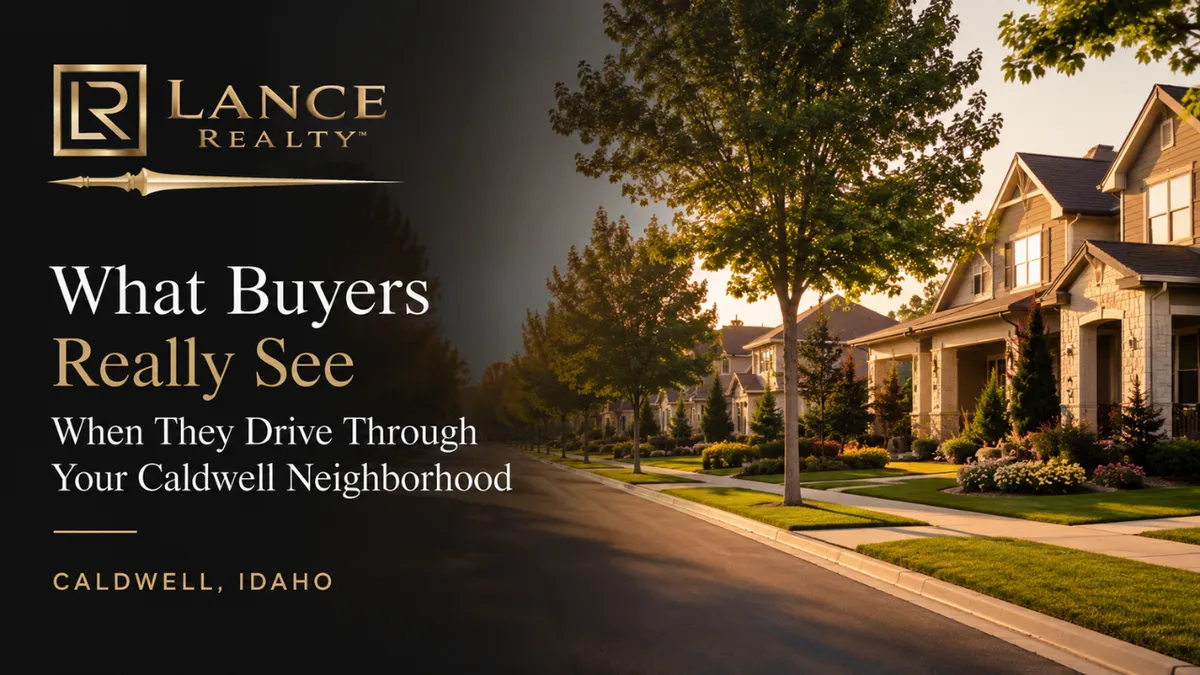
What Buyers Really See When They Drive Through Your Caldwell Neighborhood
The Turn Onto Your Street Matters More Than You Think
I've walked through a lot of homes over the past 24 years, and one thing never changes: buyers form opinions before they get out of the car. They're watching what's happening on your street. They're noticing the landscaping three doors down, the RVs parked in driveways, the condition of the sidewalks, and how the homes around you present themselves. Your house might be perfect inside, but if the neighborhood signals something else, you're working uphill from the moment they arrive.
That's not fair, but it's real. And it directly affects what buyers are willing to pay. In May 2026, the median sold price in Caldwell was $443,000 and homes sat on the market for a median of 15 days. That's faster movement than back in May 2025, when the median days on market was 27. Buyers are making quick decisions right now, and a lot of those decisions get made in the driveway.
If you're getting ready to sell in Caldwell, you need to understand what your neighborhood is telling buyers—and what you can control when so much feels out of your hands.
Not Every Caldwell Neighborhood Sells the Same Way
Caldwell isn't one market. It's dozens of smaller markets stitched together across Canyon County, and each one moves differently depending on price point, buyer pool, and what the competition looks like on any given week.
Let's say you're in at homes above the median price. Buyers in that range are usually looking at move-up homes with some finish detail and HOA amenities. They're comparing you to newer builds in Nampa and Meridian, and they're paying attention to everything from curb appeal to garage condition. If your neighbor's front yard is a mess or the street feels dated, it changes the conversation. You might still get offers, but you'll have to price tighter or prepare harder to compete.
Now compare that to a home in Manchester Park or Falcon Ridge Estates. Buyers there are often first-timers, investors, or folks looking for affordable access to the Treasure Valley. They care less about granite countertops and more about functional space, safe neighborhoods, and whether the bones of the home are solid. If your street feels run-down or the area doesn't signal "pride of ownership," buyers move on fast.
Same city. Completely different lens. And that lens determines how long your home sits and what kind of negotiating power you keep when offers show up.
What Buyers Notice Before They Walk Inside
Here's what I'd be looking at if I were driving up to your home for the first time. These are the things buyers don't say out loud, but they absolutely factor into how they feel about your property and your neighborhood.
Street condition and landscaping. Are there cracked sidewalks, overgrown parkways, or faded curbs? Is the grass mowed? Are there mature trees or just dirt and weeds? Buyers interpret maintenance level as a proxy for value and stability. A well-kept street signals pride. A neglected one signals risk.
What's parked where. RVs, boats, and work trucks parked in front yards don't bother everyone, but they bother enough people to cost you showings. Same with cars on blocks, portable basketball hoops in the street, or clutter piled near garage doors. It doesn't matter if it's allowed. It matters how it looks.
Your neighbors' homes. You can't control what your neighbors do, but buyers will absolutely hold it against you if the house next door has peeling paint, a trashed yard, or looks like it hasn't been touched in a decade. That affects your comp value and your negotiating position, especially in neighborhoods where buyer demand is soft.
The vibe of the block. Does it feel safe? Does it feel cared for? Are there kids playing outside? Garage doors open? Friendly porch setups? Or does it feel vacant, quiet, and run-down? Buyers read energy. They want to picture themselves living there, and if the neighborhood doesn't invite that feeling, they'll keep looking.
These things don't show up on the MLS listing, but they show up in offers. Or lack of them.
Pricing Your Home When the Neighborhood Works Against You
This is the hard part. If your neighborhood isn't presenting well, you can't ignore it and hope buyers don't notice. You also can't just list at the same price as the house down the street that backs to Indian Creek Plaza or sits in a newer development with clean streets and active HOAs.
Back in May 2025, the median sold price in Caldwell was $418,490. This May, it was $443,000. That's nearly a six percent jump year over year, and it tells you that overall buyer demand is solid. But that doesn't mean every home gets the benefit of that appreciation. Homes in stronger-presenting neighborhoods move faster and sell closer to list price. Homes in areas where buyers hesitate sit longer and invite more negotiation.
In April 2026, the median days on market was just 10 days. By May, it had stretched to 15. That's still quick movement, but it's also a reminder that pricing strategy matters. If you overprice in a neighborhood where buyers are already cautious, you'll sit and you'll age out of the active buyer pool. Once your listing goes stale, you're chasing the market down instead of capturing it early.
My job is to help you see the full picture before you make a move. That includes understanding where your neighborhood sits in the current Caldwell market, what buyers are comparing you to, and how we position your home so it stands out instead of sitting.
What You Can Control and What You Can't
You can't change your street. You can't force your neighbor to repaint their house or move the boat. But you can absolutely control how your property presents relative to everything around it, and that gap is where we protect your equity.
Here's what I'd be focused on if I were helping you prepare to sell right now. Your front yard and curb line. Mow, edge, mulch, and clean up the parkway. If your lawn is struggling, reseed or lay sod in the high-visibility areas. Trim trees and bushes. Make sure your house number is visible and your mailbox looks solid. First impressions aren't just about the front door. They start at the curb.
Your driveway and walkways. Pressure wash concrete. Fill cracks. Sweep up debris. If your driveway is oil-stained or your walkway is uneven, buyers see deferred maintenance before they see your remodeled kitchen.
Your garage and side yards. Buyers walk around. They look in windows. They peek at side gates. If your garage is packed with junk, your yard tools are scattered everywhere, and your fence is falling apart, they're picturing projects, not possibilities. Clean it up. Store what you don't need. Make your outdoor spaces feel cared for.
Your home's exterior. Paint touch-ups, power washing, clean gutters, replaced porch lights. These aren't big-ticket repairs, but they signal to buyers that you've maintained the home. In neighborhoods where buyers are already cautious, that signal carries weight.
The inside of your home. If the neighborhood is working against you, your home has to work harder. That means deep cleaning, decluttering, neutral paint, good lighting, and staging that helps buyers see the value. Not every pretty home is a smart buy, but a well-prepared home always performs better than one that feels tired or neglected.
How The Seller's Edge Helps You Win When Location Is the Objection
This is exactly the kind of situation where having a real strategy makes the difference. The Seller's Edge isn't about listing your home and hoping. It's about positioning your home so buyers see past the street and focus on the value you're offering.
That starts with honest pricing. We look at what sold in your neighborhood, what's active right now, and what buyers are actually willing to pay in your price range. Then we price to capture demand early, not chase it later.
Next is preparation. I'll walk your property and tell you what buyers are going to notice, what's worth fixing, and what's not. We focus on the stuff that moves the needle, not the stuff that just costs money.
Then we market your home like it matters. Professional photos, targeted digital advertising, and positioning that speaks to the buyers who are actually shopping in Caldwell right now. We don't rely on the MLS to do the work. We put your home in front of the right people and give them a reason to show up.
And when offers come in, we negotiate with a clear plan. That means understanding what buyers are comparing you to, where they'll push back, and how we hold the line on terms that protect your equity and your timeline.
You Don't Have to Apologize for Your Neighborhood
Look, not every home in Caldwell is in a picture-perfect neighborhood with tree-lined streets and HOA-maintained landscaping. That's okay. Buyers shopping in Caldwell aren't all looking for that. A lot of them are looking for value, access to the Treasure Valley, and a home they can afford without stretching into Meridian or Eagle pricing.
But you do have to be realistic about how your neighborhood presents and what that means for your pricing, preparation, and marketing strategy. Pretending the street doesn't matter doesn't help you. It just costs you time and money when your home sits longer than it should.
If you're thinking about selling in Caldwell, let's talk about your neighborhood, your home, and what it's going to take to get you the result you're looking for. I'll give you the honest answer, even if it's not the salesy answer. That's how we protect your equity and get you to closing with a number that works.
Barry Lance | Owner/Broker/Realtor® | 208-488-1433 | [email protected] | LanceRealty.com



