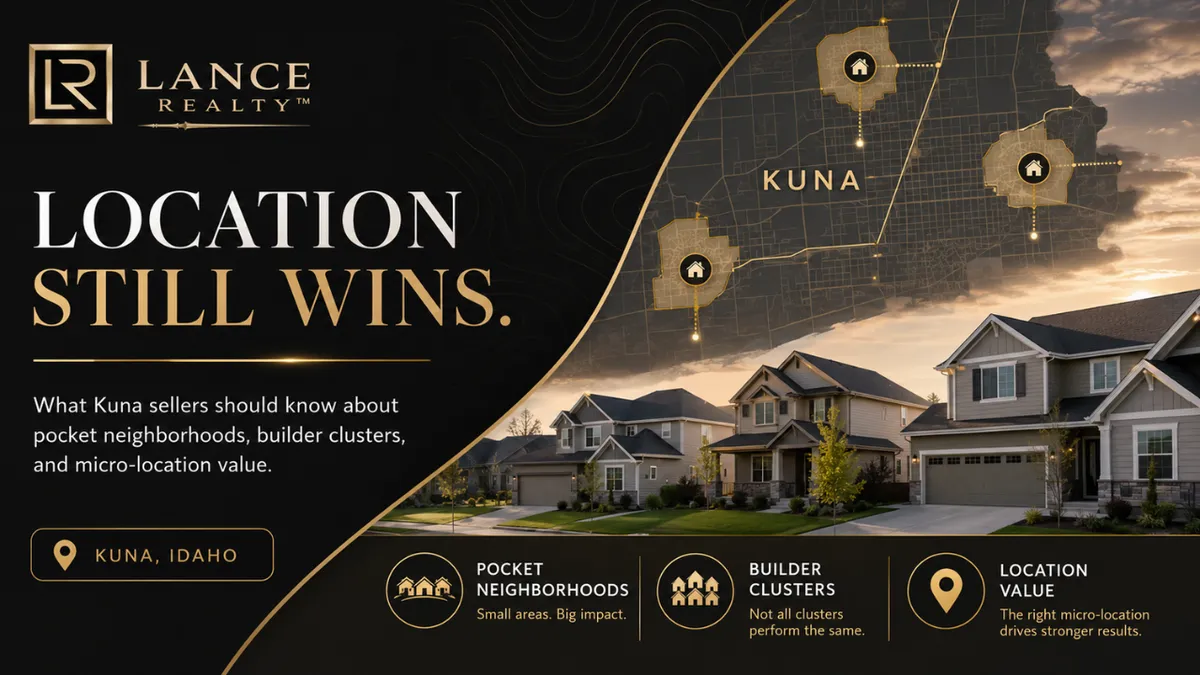
What Kuna Sellers Need to Know About Pocket Neighborhoods, Builder Clusters, and Why Location Still Matters More Than You Think
Your Kuna Address Isn't Just a Street Name—It's Part of Your Selling Story
Here's something I tell every seller before we even talk price. Your home isn't competing with every house in Kuna. It's competing with five to eight other homes that feel similar to yours, and those homes are usually sitting in the same few neighborhoods—or at least the same part of town.
That matters because buyers shopping in Kuna aren't just looking at square footage and bedroom count. They're asking questions like: Is this one of those tight-cluster subdivisions where every house looks identical, or does it have some breathing room? Is the HOA $50 a month or $200? Is this on the quiet south end near Swan Falls Road, or closer to Meridian Road where you hear a little more traffic?
If you don't understand what makes your specific pocket of Kuna different, you're going to have a hard time pricing your home right or explaining to a buyer why yours is the better pick.
Builder Clusters Are Everywhere—And Buyers Notice
Let's talk about something that doesn't show up in the MLS listing but absolutely shows up in buyer feedback. Kuna has a lot of neighborhoods where the same builder put up 40, 60, sometimes 100+ homes in the span of two or three years. Adler Creek, Cartwright Ranch, Sequoia, Bravada, Settler's Crossing, Rosewood—these aren't just subdivision names, they're builder clusters.
That's not a bad thing. Those neighborhoods brought newer construction, cleaner floor plans, and modern finishes to Kuna at a time when buyers were hungry for it. But here's what it also means: when one of those homes hits the market, it's sitting right next to four others that look almost identical on paper.
Same builder. Same year. Same elevation. Sometimes even the same paint color.
So if you're selling in one of these pockets, your edge isn't going to come from the bones of the house. It's going to come from what you did with it—the landscaping, the garage epoxy, the finished backyard, the extra storage, the way you staged it, and how we position it against the other four listings buyers are going to tour that same afternoon.
Not All HOAs Are Created Equal
I can't tell you how many times I've had a buyer say they love a home in Kuna, then pull back the second they see the HOA dues. Some neighborhoods in Kuna have HOAs under $50 a month that cover basic landscaping at the entry. Others are $150 or more and include a community pool, park, walking trails, and regular maintenance.
Neither one is wrong. But they attract different buyers, and that changes how you need to position your home.
If you're in a neighborhood with higher HOA dues and strong amenities—like some of the newer builds near Linder Road or the north end closer to Meridian—you want to make sure buyers understand what they're getting for that fee. That's not just a line item. That's a lifestyle feature, especially for families who want a pool in the summer without maintaining one themselves.
If your HOA is low or nonexistent, that's a selling point too—especially for buyers who want space, privacy, and no extra monthly obligations. Either way, don't bury it. Own it and make it part of the story.
The Kuna Market Is Still Moving—Just More Deliberately
Back in June 2026, we saw 133 homes sell in Kuna with a median sold price of $467,758. That's up from the 86 homes that sold back in June 2025 at a median of $473,745. Yes, you read that right—prices dipped slightly year over year even as volume picked up significantly.
What that tells me is this: there are more buyers active in Kuna than there were a year ago, but they're shopping carefully and they're not overpaying for homes that don't show well or aren't priced right.
Median days on market in June 2026 came in at 15 days, which is a huge improvement from the 42 days we saw in June 2025. In May 2026, that number was 20 days, and back in April 2026 it was 39 days. The trend is clear—homes are moving faster as we hit summer, but only if they're positioned correctly from day one.
If you price too high, you sit. If you don't prep the home, you sit. If your photos look like they were taken on a phone in bad lighting... you guessed it.
Why Some Kuna Neighborhoods Sell Faster Than Others
Not every part of Kuna performs the same way. I work with sellers all over town, and I can tell you that buyer demand shifts depending on where you are and what you're offering.
Neighborhoods near Linder Road and the north end of Kuna—places like Bravada, Cartwright Ranch, Settler's Crossing—tend to attract buyers who want newer construction and easy access to Meridian. These buyers are often coming from rentals or upgrading from smaller homes. They want clean, move-in-ready, and modern.
South Kuna and the areas around Swan Falls Road pull a different buyer—someone looking for more land, more privacy, and that true small-town Kuna feel. These buyers aren't as concerned about granite counters or open-concept floor plans. They want space, outbuildings, and room for toys.
Then there are the older pockets near downtown Kuna—Treasure Acres, York Farms, parts of Kuna Farms—where you've got a mix of older homes on bigger lots. These can be goldmines for the right buyer, but they also require more work to position because you're not selling new construction. You're selling character, location, and potential.
Understanding where your home sits in that lineup changes everything about how we price it, market it, and talk to buyers.
The Pocket Neighborhood Advantage (Or Disadvantage)
Here's a term I use with clients all the time: pocket neighborhood. It's a small cluster of homes—usually 20 to 50—that feels like its own little world even though it's technically part of a bigger area.
Kuna has a ton of these. Emerald Isle. Quail Hollow. Fox Run. Sagebrush Estates. Dry Creek. Morning Mist. These aren't the big 200-home subdivisions. They're the quiet spots tucked behind a main road or at the end of a cul-de-sac where everybody knows everybody and it feels more neighborhood than subdivision.
If you're selling in one of these, that's a story worth telling. Buyers love the idea of a tight-knit community, and if your neighbors take pride in their homes, that shows up in photos, curb appeal, and the overall vibe when a buyer pulls up.
But here's the flip side. If one or two homes in that pocket look rough—overgrown yards, peeling paint, old roofs—it drags the whole street down in the eyes of a buyer. You can't control what your neighbor does, but you can absolutely control how your home compares.
Why I Always Walk the Neighborhood Before We List
Before I list a home in Kuna, I walk the street. I drive the neighborhood. I look at what else is listed, what just sold, and what's sitting. I want to know what a buyer is going to see when they pull up, because that first impression happens before they ever step inside your house.
If I see three other homes for sale on the same street, that changes our strategy. If the house next door just closed for $20K under asking, we need to talk about that. If the neighborhood has a park, a walking path, or a community garden that buyers won't find on Zillow, I want that in your listing description and in our marketing.
This is part of what I call The Seller's Edge. It's not just about listing your home—it's about positioning it with a clear understanding of where it sits in the market, what makes it different, and how we can tell that story in a way that gets buyers to move.
Location Still Matters More Than Square Footage
I had a seller last year who couldn't understand why her 2,200-square-foot home in one part of Kuna was getting less interest than a 1,800-square-foot home two miles away. Same price range. Same condition. But the smaller home was in a newer pocket with better access to Meridian, lower HOA dues, and a more desirable school zone.
Square footage matters. But location, builder reputation, neighborhood feel, and proximity to what buyers actually care about? Those matter more.
If you're selling in Kuna, you need to know what your specific location brings to the table. Is it the space? The schools? The quick commute to Boise? The small-town vibe? The fact that you're two minutes from Meridian but still technically Kuna?
Whatever it is, that's your hook. And if you don't lead with it, someone else will.
What This Means for You Right Now
If you're thinking about selling in Kuna, don't assume your home will sell itself just because the market is moving. In June 2026, the average sold price was $514,929 with homes sitting an average of 39 days. That's a healthy market, but it's not a seller's free-for-all.
Buyers are comparing your home to others in your neighborhood, your builder cluster, and your price range. They're asking smart questions about HOA fees, location, and long-term value. And they're walking away from homes that feel overpriced or underprepared.
My job is to help you see your home the way a buyer will see it—and then position it, price it, and market it in a way that makes it the obvious choice. That's what The Seller's Edge is all about, and it's the system I use with every seller I work with in Kuna.
If you want to know where your home sits in today's market, what buyers in your neighborhood are actually looking for, and what it's going to take to sell strong in the next 30 to 60 days, let's talk. I'll give you the honest answer, even when it isn't the easiest answer.
Barry Lance | Owner/Broker/Realtor® | 208-488-1433 | [email protected] | LanceRealty.com



