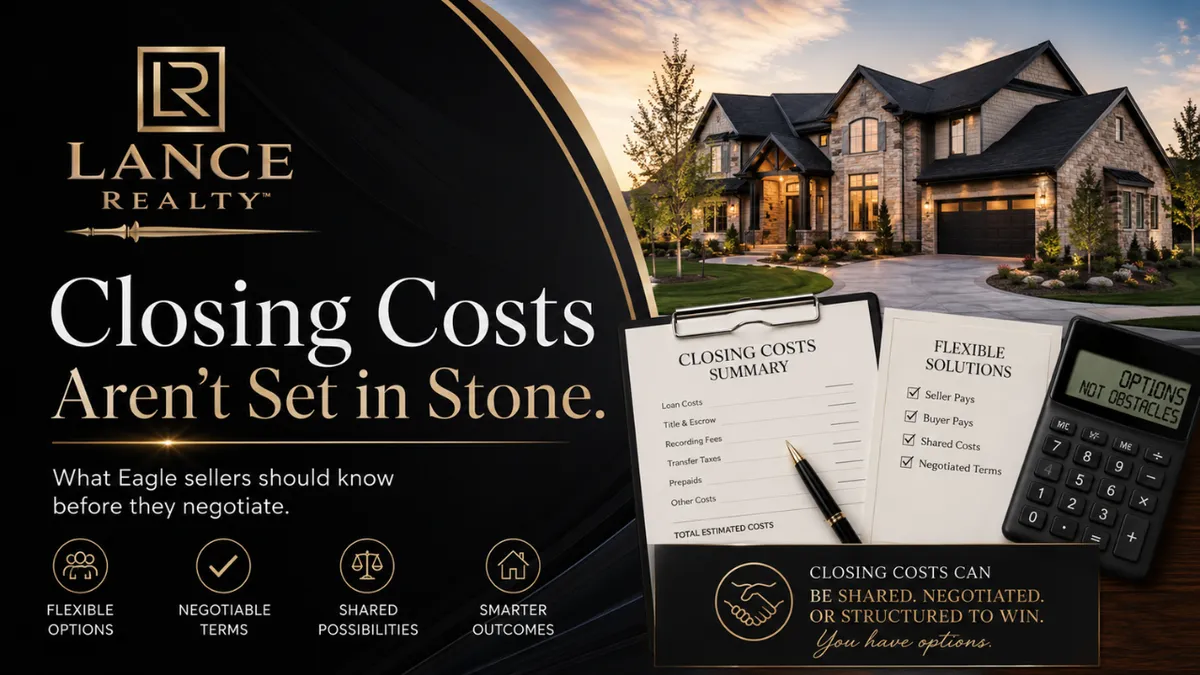
Who Really Pays Closing Costs When You Sell Your Eagle Home? (Spoiler: It's More Flexible Than You Think)
The Question I Hear All the Time: "Barry, What Are My Closing Costs Going to Be?"
It's one of the first things sellers ask me when they're thinking about listing their Eagle home. And it makes sense. You want to know what you're actually walking away with at the end of this thing.
Here's the short answer: On a typical Eagle home sale in the $1 million range, you're looking at somewhere between $15,000 and $30,000 in closing costs, sometimes more depending on what you agree to cover for the buyer. That's real money. And it's not always the same from one transaction to the next.
So let's break down what Idaho sellers actually pay, what's negotiable, and where you might have more control than you think.
The Big One: Real Estate Commission
This is usually your largest closing cost. In Idaho, real estate commission is negotiable, but it typically runs around 5% to 6% of the sale price. That amount gets split between the listing side and the buyer's side.
On a home that sells for $1,236,729 (the average sold price in Eagle back in July 2026), a 6% commission would be about $74,204. That's a big chunk. And yes, it comes out of your proceeds at closing.
Here's what I tell sellers: Commission isn't just about getting your home listed. It's about how your home gets positioned, marketed, negotiated, and closed. A strong agent protects your equity in ways that go far beyond the listing photos.
You can negotiate commission. But don't do it in a vacuum. If you're trying to shave a point off the commission while also pricing your home $50,000 over market and skipping the staging, you're not saving money. You're costing yourself a sale.
Title and Escrow Fees: Who Pays for What in Idaho?
In Idaho, it's customary for the seller to pay for the buyer's title insurance policy. That's the big one. It usually runs around 0.5% to 1% of the purchase price, so on a $1 million home, you're looking at $5,000 to $10,000.
Escrow fees are typically split between buyer and seller, but that can be negotiated. Escrow handles the closing process, holds funds, records documents, and makes sure everyone gets paid correctly. You're usually looking at a few hundred to a thousand dollars for your share.
Then there are things like the settlement or closing fee, wire fees, notary fees, and recording fees. These add up to another $500 to $1,500 depending on your escrow company and the complexity of your sale.
None of this is set in stone. In a strong seller's market, you might push more of these costs to the buyer. In a softer market, you might cover a little more to help the deal close. It all depends on leverage, and that starts with how well your home is priced and prepared.
Seller Concessions: The Wildcard
This is where things get interesting. Seller concessions are costs you agree to cover on behalf of the buyer. They might ask you to pay some or all of their closing costs, cover a home warranty, or chip in for repairs after the inspection.
In July 2026, Eagle had 104 homes close. The median sold price was $1,004,500, and homes were spending a median of 27 days on market. That's not a lightning-fast market, but it's not slow either. Buyers still have options, and they're asking for concessions when they see an opportunity.
I see concessions range anywhere from $2,000 to $15,000 depending on the situation. Sometimes more if there's a big repair issue or the buyer is stretching to qualify.
Here's my take: Concessions aren't automatically a bad thing. If a $5,000 concession gets your home sold at full price instead of sitting for another 60 days and dropping $20,000, that's a win. But you don't want to give concessions away just because a buyer asks. You want to negotiate them strategically, and that requires knowing your position in the market.
Prorated Property Taxes and HOA Dues
These aren't technically "closing costs," but they do come out of your proceeds at closing. You'll pay your share of property taxes up to the closing date, and the buyer pays from that point forward. Same with HOA dues if you're in a neighborhood with an association.
If you close in August and your property taxes are $6,000 a year, you're covering about eight months of that. It's prorated down to the day. Same with HOA dues. If your HOA is $100 a month and you close mid-month, you'll credit the buyer for the second half.
It's not a huge cost, but it's worth factoring in when you're calculating your net proceeds.
Repairs, Credits, and Inspection Surprises
This is the one that catches sellers off guard. You get an offer, you're feeling good, and then the inspection comes back with a list of issues. Some are minor. Some are not.
Buyers in Eagle aren't shy about asking for repairs or credits, especially if your home has been on the market for a while or if there are visible maintenance issues. I've seen sellers cover everything from a $300 sprinkler fix to a $12,000 roof replacement credit.
The key is knowing what's worth fixing before you list and what's better handled as a credit or price adjustment. That's part of what we walk through in The Seller's Edge system. You want to go into the listing process with a clear plan for how you'll handle inspection requests, not make it up on the fly when you're already emotionally invested in the sale.
What About Buyer-Requested Closing Cost Coverage?
Some buyers, especially first-timers or folks moving from California with equity but tight cash reserves, will ask you to cover part or all of their closing costs. It's written into the offer as a seller concession.
Is it required? No. But if the market is soft or your home has been sitting, it might be the difference between a closed sale and starting over.
Here's how I look at it: If a buyer offers you $1,020,000 and asks for $10,000 in closing cost help, they're really offering you $1,010,000. Don't get distracted by the bigger number. Look at your net. Compare it to other offers. Then decide.
And if you're getting multiple offers and your home is priced right, you don't have to cover a dime. That's the power of positioning your home correctly from day one.
What You Can Control (and What You Can't)
You can't control commission structures across the industry. You can't control Idaho's customary practices around title insurance. And you can't control what a buyer is going to ask for in their offer.
But you can control how your home is priced, how it's presented, and how prepared you are for negotiation. A well-priced home in Eagle that's clean, staged, and move-in ready doesn't sit on the market for 71 days like the average in July 2026. It moves faster, attracts stronger buyers, and gives you negotiating leverage when the offers come in.
That's where most sellers leave money on the table. Not in the closing costs themselves, but in the lack of strategy that leads to weak positioning, long market time, and price reductions that wipe out any savings they thought they were getting by skimping on prep or pricing aggressively.
For more context on how these costs compare to other deal structures, check out this breakdown: Traditional Sale vs. Cash Offer in Meridian: What Most Sellers Get Wrong About the Real Costs.
How The Seller's Edge Helps You Plan for This Stuff
One of the first things I do with sellers is walk through a net proceeds estimate. We plug in your expected sale price, your mortgage payoff, your estimated closing costs, and any likely concessions or repairs based on your home's condition and the current market.
You see the number before you list. No surprises at closing.
Then we build a plan to maximize that number. That means pricing your home based on what buyers are actually paying (not what Zillow says), preparing it so it shows well against the competition, and marketing it in a way that attracts serious offers, not tire kickers.
It's not flashy. But it works. And it protects your equity in ways that a discount commission or a quick-list strategy never will.
Final Thought
Closing costs are part of the deal. You can't avoid them. But you can control how much leverage you have when it comes time to negotiate who pays what. And that leverage comes from doing the upfront work that most sellers skip.
If you're serious about selling your Eagle home and want to know exactly where your money is going, let's talk. I'll walk you through the numbers, show you what to expect, and help you build a plan that makes sense for your situation.
Have more questions about selling your Eagle home? Visit our Eagle Home Selling FAQ for straight answers on pricing, closing costs, timing, and more.
Barry Lance | Owner/Broker/Realtor® | 208-488-1433 | [email protected] | LanceRealty.com



