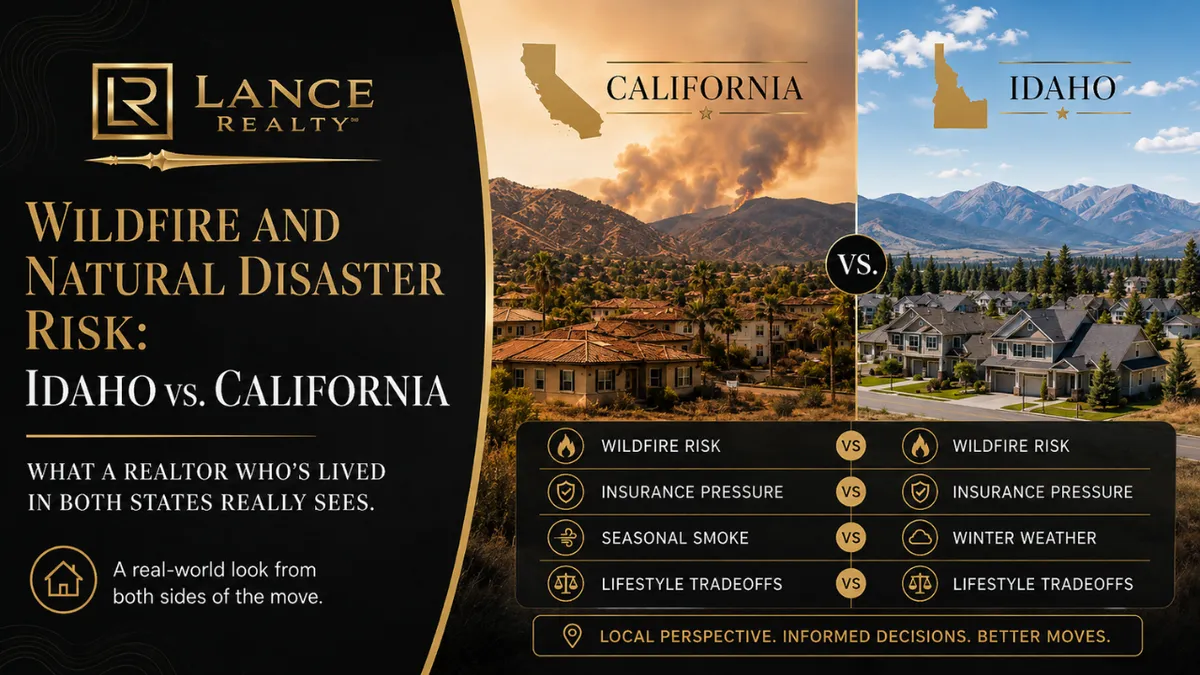
Wildfire and Natural Disaster Risk: Idaho vs. California, What a Realtor Who's Lived in Both States Really Sees
You're Not Wrong to Ask About Fire Risk Before You Move
I get this question almost every week from California buyers. You're looking at homes in Boise, Eagle, or Meridian. The numbers work. The lifestyle fits. Then you pause and ask: what about wildfires?
It's a fair question. You're coming from a state where fire season isn't a season anymore. It's year-round. You've watched insurance companies pull out of entire counties. You've packed a go-bag. You've had friends lose homes in Contra Costa County or watched the Santa Ana winds turn neighborhoods into evacuation zones overnight.
So before you sell your California home and move to Idaho, you want the real answer. Not the Chamber of Commerce version. The version that helps you make a smart decision for your family.
Here's what I'll tell you. Idaho has wildfire risk. The Treasure Valley has wildfire risk. But it's not the same risk you're living with in California. Not even close.
The Treasure Valley Sits in a Very Different Fire Zone Than Most of California
When people think Idaho, they picture forests. Mountains. Timber. And yes, northern Idaho and central Idaho have significant wildfire exposure. The Boise National Forest, the Sawtooth Range, McCall, Sun Valley. Those areas burn. They burn hard some years.
But the Treasure Valley sits in the high desert. Boise, Eagle, Meridian, Star, Kuna, Nampa, Caldwell. We're not surrounded by dense timber. We're surrounded by sagebrush, cheatgrass, and open range. Our biggest wildfire fuel is invasive annual grasses that green up in spring and dry out by July.
That doesn't mean there's no fire risk. Grass fires move fast. The foothills above Boise and Eagle can ignite during dry, windy conditions. In 2020, the Pearl Fire burned more than 1,000 acres in the Boise foothills and came close to developed neighborhoods. In 2016, the Tablerock Fire did the same.
But here's the difference. Those fires don't behave like California fires. They don't carry the same fuel load. They don't generate the same intensity. And critically, they don't burn through densely packed housing developments surrounded by decades of overgrown chaparral and eucalyptus.
In California, you've got millions of people living in the wildland-urban interface. Homes built into canyons. Roads with one way in and one way out. Power lines running through tinder-dry vegetation. When fire starts, it moves through neighborhoods with terrifying speed.
The Treasure Valley doesn't have that same structural risk. Our valley floor is flat, open, and low-fuel. Our neighborhoods don't sit in forested canyons. We don't have the same ignition profile.
Fire Insurance in Idaho Is Still Easy to Get and Affordable
Here's where the difference really shows up. If you're selling a home in parts of California right now, you know what's happening with homeowners insurance. FAIR Plan. Non-renewals. Premium increases that feel like a second mortgage payment.
In Idaho, fire insurance is normal. It's included in your standard homeowners policy. No special riders. No carve-outs. No insurance company pulling coverage because of your zip code.
I've worked with dozens of California buyers over the last two years. Not one has had trouble securing homeowners insurance in Boise, Eagle, Meridian, or any other Treasure Valley city. Rates are reasonable. Coverage is straightforward. The underwriting process doesn't require a wildfire mitigation inspection or a letter from the fire department.
That alone is a quality-of-life shift most California buyers don't fully appreciate until they're here.
What About Earthquakes, Floods, and Other Natural Disaster Risks?
Idaho sits near a seismic zone. We had a 6.5 magnitude earthquake near Stanley in 2020. It rattled Boise hard enough that people noticed. But structural damage was minimal. Idaho has building codes. Homes here are built to handle seismic activity better than many older California homes.
Flooding? The Boise River runs through the valley. In heavy snowpack years, there's flood risk in specific zones near the river. Garden City, parts of Eagle near the greenbelt, low-lying areas in West Boise. But the city manages flow aggressively through the dam system, and flood insurance is required only in designated FEMA flood zones. Most Treasure Valley homes aren't in those zones.
Tornadoes are extremely rare. Hurricanes don't exist. We don't have coastal storm surge, landslides on the scale you see in the California hills, or atmospheric rivers that drop 10 inches of rain in 24 hours.
The natural disaster risk profile in Idaho is fundamentally lower than what you're living with in California. That's not marketing. That's geology and climate.
The Treasure Valley's Real Seasonal Challenge Is Air Quality, Not Fire
Here's what I'll be honest about. During bad fire years in the northern Rockies, the Treasure Valley gets smoke. Sometimes for weeks. August and September can bring hazy skies and poor air quality from fires burning in Oregon, Washington, Montana, and northern Idaho.
It's not fun. If you have asthma or respiratory issues, it matters. You'll want a good HVAC filter. You'll check the AQI app. You'll keep windows closed on bad days.
But you're not evacuating. Your home isn't threatened. The smoke is coming from fires burning hundreds of miles away. It's an air quality issue, not a survival issue.
Compare that to living in the East Bay during fire season. You've got smoke plus the real threat of ignition in your own neighborhood. You've got PG&E shutting off power for days at a time. You've got evacuation warnings going to your phone while you're trying to sleep.
The psychological load is completely different.
Where You Buy in the Treasure Valley Doesn't Change Your Fire Risk Much
If you're asking whether Boise is safer than Eagle or Meridian is safer than Star, the answer is no. Fire risk across the valley floor is negligible. The areas with slightly elevated risk are homes built directly into the foothills above Boise and Eagle. Those properties back to open space and sagebrush. They're beautiful. They have views. And they carry a bit more exposure during dry years.
But even those homes aren't sitting in California-level fire zones. The fuel isn't there. The ignition frequency isn't there. And the fire departments in Ada County and Canyon County are well-equipped and responsive.
Most California buyers I work with aren't looking at foothill properties anyway. They're looking at neighborhoods in Eagle, Meridian, Star, or West Boise. Subdivisions with parks, schools, and access to amenities. Those areas have functionally zero wildfire risk.
What This Means for Your California-to-Idaho Move
If fire risk is part of what's pushing you out of California, you're making the right call. The Treasure Valley is objectively safer from wildfire than most of Northern California, the Central Valley foothills, or Southern California's wildland-urban interface.
Your homeowners insurance will be easier to get and cheaper to keep. Your kids won't grow up with annual evacuation drills. You won't wake up checking CAL FIRE maps or wondering if this is the year your neighborhood burns.
That peace of mind is real. It's one of the reasons so many California families are making this move right now.
But here's what I also tell buyers. Don't move to Idaho just because you're running from something. Move because you're moving toward something. The lifestyle. The space. The cost of living. The slower pace. The community.
Wildfire risk might be the trigger that gets you looking at Idaho. But it shouldn't be the only reason you move. You need to land in the right city, the right neighborhood, and the right price point for your family. That's where my job starts.
How Barry Helps California Buyers Navigate the Treasure Valley Market
I've lived and worked in both California and Idaho. I understand what you're leaving behind and what you're hoping to find here. My job is to help you see the full picture before you make a move.
That means helping you understand which Treasure Valley city fits your lifestyle. What your California equity really buys here. How to time the sale of your California home so you're not stuck carrying two mortgages or scrambling to close remotely. And how to evaluate Idaho contracts, new construction timelines, and neighborhood dynamics from out of state.
Fannie Mae's June 2026 Housing Forecast projects mortgage rates to average 6.3% throughout 2026, revised upward from earlier forecasts due to economic and geopolitical uncertainty. Freddie Mac's weekly survey recorded the 30-year fixed at 6.55% as of mid-July, and NAR's chief economist Lawrence Yun forecasts a 14% increase in existing home sales for 2026 as lower rates and rising inventory unlock additional qualified buyers. That's good news for California buyers who've been waiting for the right window to move.
The Treasure Valley market is stabilizing. Zillow's 12-month forecast for the Boise metro reflects a modest expected decline of approximately 2.2% from June 2025 to June 2026 as the market rebalances, and statewide home price appreciation is projected in the 3% to 5% range. Inventory is up. Days on market are reasonable. Buyers have room to negotiate without the chaos of 2021 or the sticker shock of peak pricing.
If you're serious about moving from California to Idaho, now is a smart time to start planning. Not panic-buying. Planning.
Planning a move from California to Idaho? Visit our California to Idaho Relocation FAQ for straight answers on costs, cities, taxes, and the ListBuySave plan.
Barry Lance | Owner/Broker/Realtor® | 208-488-1433 | [email protected] | LanceRealty.com



